
South Carolina Parole Board Role
The South Carolina Board of Paroles and Pardons is the statewide decision body. It has seven members, one from each congressional district. The Governor appoints them with Senate approval, and they serve staggered terms. The Board may grant or deny parole and pardons. It also has authority over parole revocation, modification, and rehearing, plus recommendations on certain gubernatorial reprieve or commutation referrals.
The Board is not the same as a county supervision office. SCDPPPS staff supervise a case after release, but they do not replace the Board's grant or denial. SCDC maintains prison custody and the later release entry. That split creates three records: the Board event or outcome, the SCDC physical release record, and the SCDPPPS supervision record.
The official Board of Paroles and Pardons landing page is the durable source for current calendars, minutes, and Board materials.
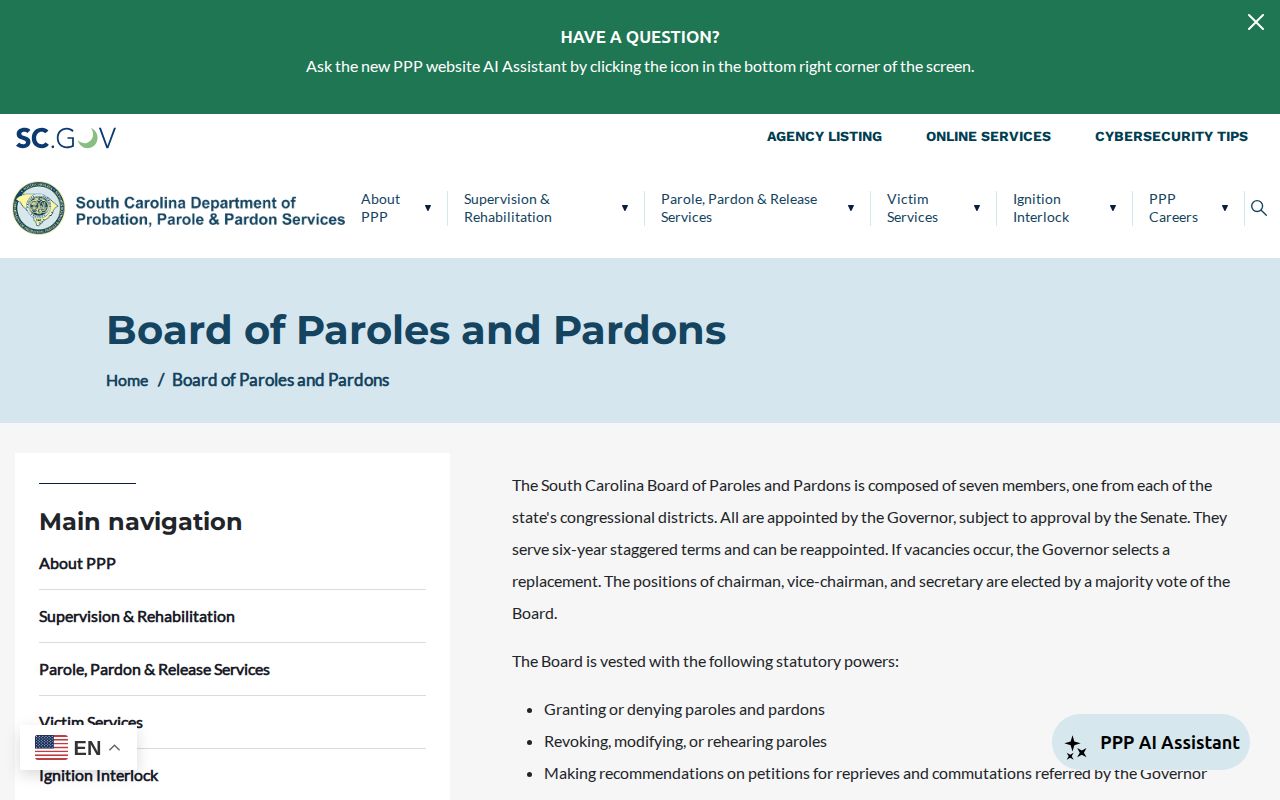
The durable page is safer to retain than an annual PDF alone because the linked calendar can change by year or revision.
South Carolina Parole Hearing Calendar
The verified 2026 calendar is an annual planning document. It lists Full Board, Single Panel, pardon, and administrative meeting dates by month and is marked revised December 15, 2025. Those meeting categories organize Board work. The calendar is not a list of people, and it does not prove that a named person will be heard on a given day.
Use the Board landing page first. Open the calendar currently linked there and read its year and revision mark. Then move to the person-specific search for the individual. This two-source method avoids treating an old PDF as current and avoids treating a general meeting day as an individual case notice.
- Open the durable Board page and select its current annual calendar.
- Confirm the calendar year and any revision date printed on the document.
- Identify the relevant meeting type, but do not infer a person's date from that row.
- Use the person-specific hearing search to locate the named case.
- Check again near the expected event because schedules can be revised.
Note: The annual South Carolina Board calendar plans meeting days; only the named search connects a specific person to a hearing.
Find South Carolina Hearing Dates
The official Parole and Pardon Hearings search accepts several combinations for parole records. Valid paths are first plus last name, SCDC number alone, first name plus hearing month, last name plus hearing month, or hearing month alone. A month-only search can return many records, so a number or full name is more useful when known.
SCDPPPS says hearing dates become available about 30 days before the event. That is an approximate posting window, not a daily update guarantee. Search periodically. A date can be rescheduled, and results or other updates may be delayed. Save the exact name, SCDC number, month, and source date used to identify the record.
- Choose the parole search, not the separate pardon search on the same page.
- Enter one of the combinations the live form permits.
- Compare the name and SCDC number before relying on a match.
- Read the hearing month and date as a schedule, not as a decision.
- Return periodically for a reschedule or posted result.
The person-specific hearing and results interface shows why the individual search must follow the general calendar.
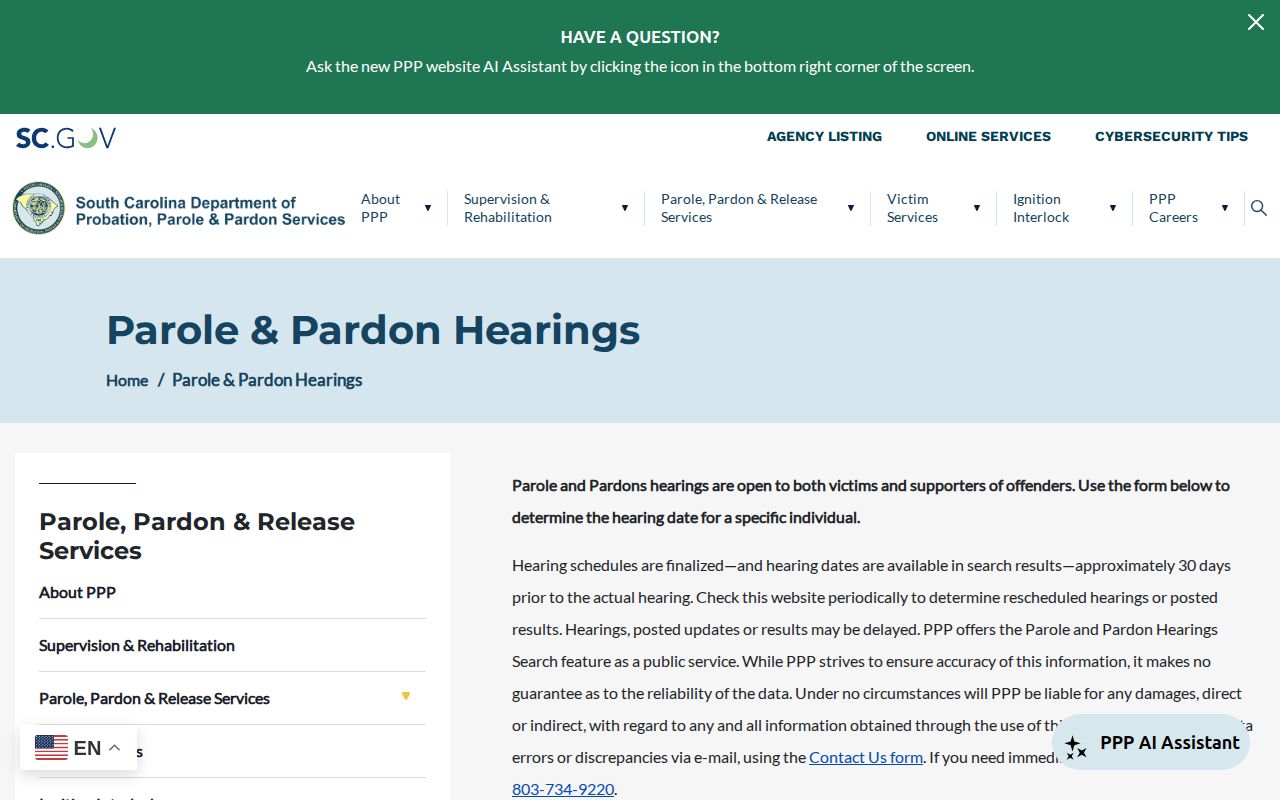
The same official interface serves as the published result channel after the Board acts.
Check South Carolina Parole Decisions
No separate statewide parole-decision database was verified. The hearing search is also the official published result source. A scheduled date is not an outcome. Return to the matching case after the event and read the posted result. Delays can occur, so the lack of an immediate result should be described as pending verification rather than as a denial or grant.
A grant authorizes the next stage. It does not supply the physical release timestamp. SCDC still completes its release audit, checks the authority and detainers, prepares the applicable documents, and processes the departure. A denial may lead to a later rehearing. Official participant guidance says a one-year or two-year period may apply depending on offense date and classification. Do not assign a universal interval.
- Reopen the same person-specific Board search used for the schedule.
- Match the identity again before reading the posted result.
- Record the outcome and the date on which the official source was checked.
- For a grant, find the later actual Release Date and Release Type in SCDC's released search.
- Check SCDPPPS after departure to verify continuing parole supervision.
| Published event | What it establishes | What it does not establish |
|---|---|---|
| Scheduled hearing | A planned Board event for the matched person | A vote or release |
| Rescheduled date | The prior date changed | Why the case changed or its result |
| Grant | A favorable Board decision | The gate time or unrestricted discharge |
| Denial | Parole was not granted at that event | One universal future rehearing date |
| No posted result yet | Nothing conclusive by itself | Grant, denial, or cancellation |
South Carolina Parole Eligibility
Eligibility permits Board consideration. It is not a promise of parole. Section 24-21-610 is sensitive to offense, sentence, and governing date. Its framework includes one-third of a term of 30 years or less and ten years for life or a term over 30 years under the general provision. Later implemented-system language includes at least one-third or the mandatory minimum, whichever is longer, for a violent crime, and one-fourth for another crime, with ten years for life or a term over 40 years.
The same statute preserves specific ineligibility tied to murder, armed robbery, drug trafficking, no-parole offenses, and other provisions. Good-behavior deductions do not shorten eligibility, although the law addresses earned-work credit. These exceptions are why no universal fraction should be applied to one person without the offense, sentence, and controlling date.
Review the text of South Carolina Code Title 24, Chapter 21 with the judgment and SCDC calculation. The separate South Carolina inmate release-date record addresses projections and credits, while the Board source controls the hearing event.
Confirm South Carolina Parole Release
The proof chain has a fixed order: eligibility source, named hearing schedule, posted Board outcome, actual SCDC Release Date and Release Type, then SCDPPPS supervision verification. Skipping a stage changes the claim. A projected eligibility date only indicates when consideration may occur. A schedule only indicates a planned event. A grant is a decision. The released list records the prison exit.
SCDC's ordinary current search covers people currently sentenced to and incarcerated in SCDC and uses prior-midnight data. Its disclaimer says released offenders and supervision cases are excluded. A person disappearing from that search after a grant may have been released, but absence still is not proof. Use the separate SCDC Released Inmate Search, which is organized by release-date range and county, and read the exact Release Type.
The official SCDC current-inmate disclaimer states the current tool's released-person exclusion.
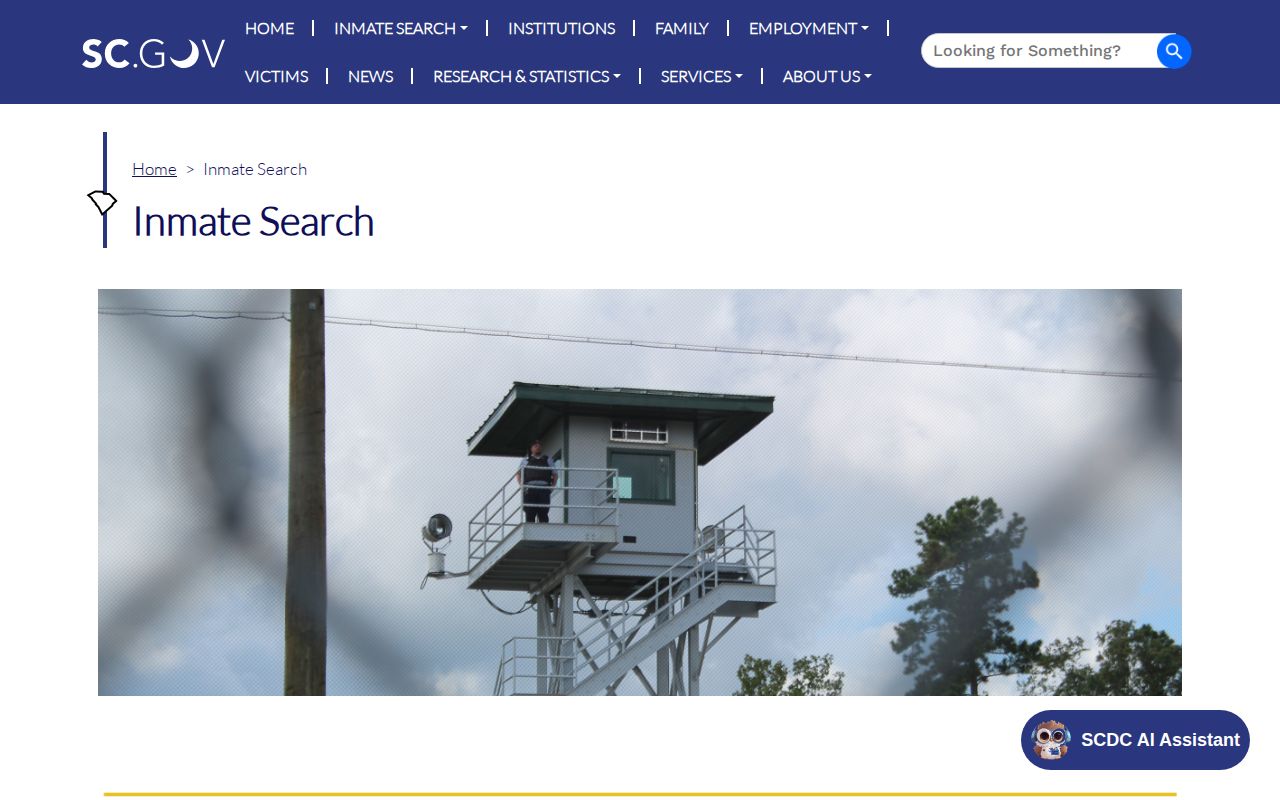
That exclusion is why a no-result must be followed by the released search instead of being called a confirmed parole release.
When searching the released list, begin with the best-supported date range and select the relevant county or All Locations if the county is uncertain. Results appear in a release-specific list and include Release Date and Release Type. Export can add details such as detainer and most-serious-offense information. A detainer can mean transfer to another custodian, so even a parole-related departure should not be described as unrestricted release without the receiving-authority check.
South Carolina Parole Supervision
Parole is conditional release, not erasure of the sentence. Once SCDC records the actual departure, SCDPPPS administers supervision. Its Offender Search accepts a full name, SID, birth-year combinations, and county combinations. The public data represents the previous day, so current-day questions belong with the assigned county office.
A positive SCDPPPS result helps connect the Board grant and SCDC exit to active supervision as of the data date. A negative result does not prove the sentence ended. Someone no longer supervised may be omitted, identifiers may be wrong, or another authority may control the person. Formal closure should come from the responsible agency record.
The SCDPPPS supervision search is the official post-release check after a confirmed parole exit.
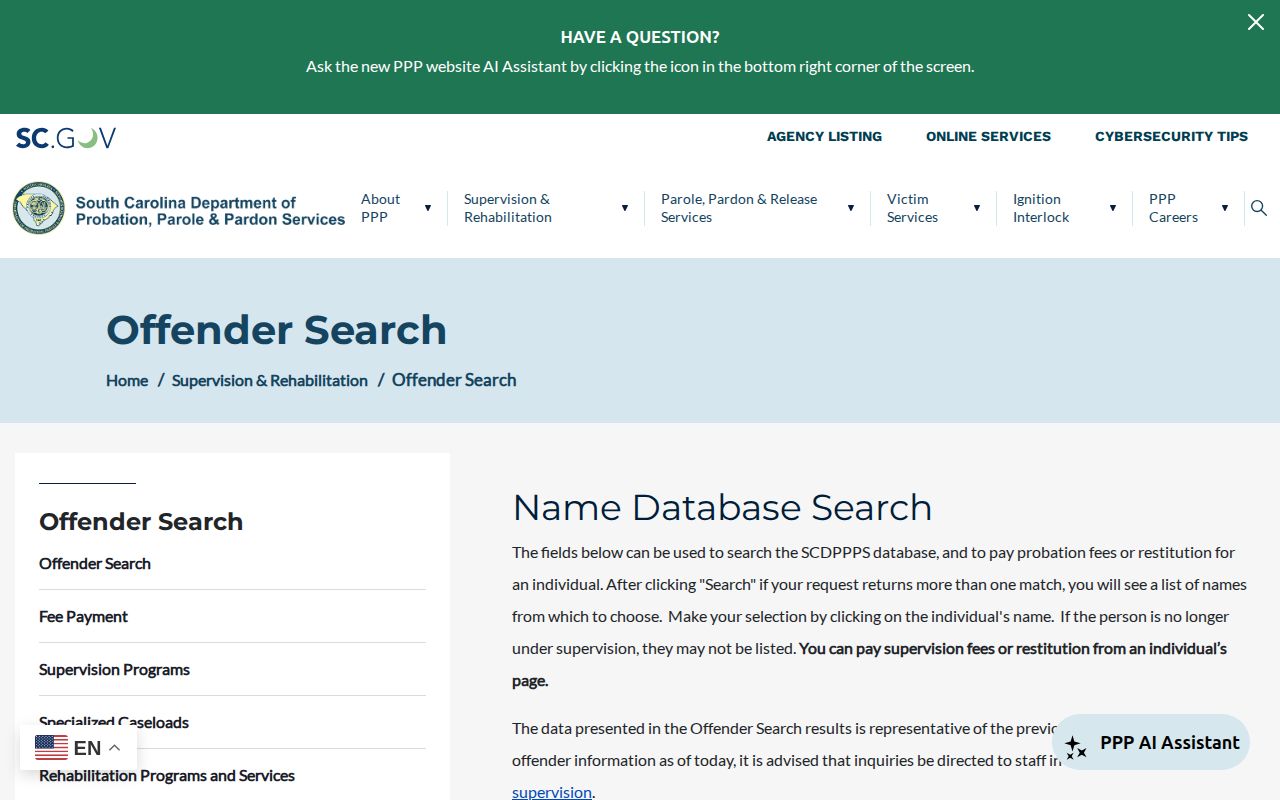
The data date should be reported with the match because the web result is not a live same-day status feed.
More detail on active case verification appears under South Carolina Parole / Probation.
South Carolina Pardons and Hearings
The Board also decides pardons, but a pardon search is separate from the parole search even though both appear on the same service page. The live interface has an inconsistency: the pardon number field is labeled SCDC# while its combination note refers to SID#. Follow the live form as displayed and avoid rewriting that ambiguity into a firm identifier rule.
A pardon is not the same as parole, probation completion, or release from prison. State law calls for a certificate when a pardon is granted. A parole grant, by contrast, begins the release-processing and supervision chain. The record should retain the exact action rather than describe every favorable Board event as discharge.
The official hearing participation information explains participation and post-decision communication for those covered by that service. Use the current page because procedures can change. It does not replace the public schedule, outcome search, or actual SCDC release record.
Keep each Board record in its own lane. The annual calendar establishes planned meeting dates. The named search establishes a scheduled case and later published result. Minutes document Board business, while the pardon certificate documents a granted pardon. None of those items alone supplies an SCDC gate time. Exact labels and dates prevent a pardon event, parole vote, and physical release from being merged into one claim.