
SCDC Offender Search Paths
South Carolina maintains two official applications with distinct purposes. The Incarcerated Inmate Search covers people currently sentenced to and held by SCDC. Its data reflects the prior midnight. The agency warns that it leaves out released prisoners, county detainees, people on community supervision, fugitives, and protected juveniles. A blank current-search result is not proof that someone walked free. It can also point to another custodian, a scope limit, a transfer, or an identifier error.
For a past state-prison exit, use the SCDC Released Inmate Search. It does not begin with a name. Searchers enter a beginning and ending release date, choose a county, ALL LOCATIONS, or OUT-OF-STATE, and may apply the sex-offender filter. Results appear ten at a time, with paging and an export option. The best method is to start with the narrowest well-supported date span, then widen it if needed. Choose All Locations when the county association is not known.
The SCDC current-search disclaimer shows why the two-search model matters.
The exclusion means a search must move to the released list rather than treat roster absence as a release record.
Search SCDC Released Inmates
A disciplined lookup separates people with the same or similar names. SCDC ID and SID are stronger identifiers than name alone. Age, sex, race, the selected county value, and the release date can help test a match, but the county filter must be read with care. It associates an SCDC state-prison release with the chosen county. It does not prove that the person left a county detention center there, exited a prison building there, or now lives there.
- Identify whether the person was sentenced to SCDC, held in a county jail, or confined by a federal or other authority.
- Check the current SCDC locator when state custody remains possible, and compare SCDC ID, SID, age, and other known facts.
- Open the released list when an SCDC exit is plausible. Enter a supported date range and select the county or All Locations.
- Read the exact Release Date and Release Type. Export the results when SID, detainer, or most-serious-offense detail is needed.
- Check SCDPPPS for supervision and the court docket for the judgment or later order. Request the agency record if a key field is absent.
No official source reviewed gives a guaranteed historical-retention span for the online released list. The form accepts date ranges, but that function does not promise permanent access. An old or missing release should go to SCDC Inmate Records or a focused Freedom of Information Act request. Do not describe the tool as a permanent name database.
The SCDC agency and statistics hub places the current search, released list, calculator, records information, and agency research in one official setting.
That hub is a useful reset point when a saved application link changes or a search needs an agency source.
SCDC Release Record Fields
Inclusion in the released list, paired with the Release Date and Release Type, is the evidence of departure from SCDC custody. The list does not add a generic status field labeled Released or Discharged. Its normal display also does not show a released-person photograph. When a public historical institutional image is needed for a purpose-neutral reason, use the SCDC number and request any releasable image, subject to applicable exemptions.
| Field | How to read it |
|---|---|
| SCDC ID | The corrections identifier used to distinguish people and connect records. |
| Name and traits | Name, sex, race, and age help test a possible match but should not replace the ID. |
| Sex-offender indicator | A specific released-list field and filter, not a general description of the record. |
| Release Date | The recorded SCDC prison-exit date, unlike a future projected date. |
| Release Type | The agency category for the exit, which may show supervision, sentence expiration, a court event, or another outcome. |
| County | An association used by the SCDC list, not proof of county-jail release, exit site, or present home. |
| Export fields | SID, victim indicator, detainer indicator, and most-serious-offense data can appear in the export. |
Read the release type without translating every exit into unrestricted community release. SCDC reporting includes expiration or maxout less permitted credits, probation, several parole categories, community supervision, supervised reentry, resentencing, death, execution, and an other group. The last group can include court order, paid fine, appeal bond, pardon, remand to county, or furlough. A detainer is a request or authority that can cause transfer to another custodian. Death is an exit statistic, not reentry.
Note: Preserve the exact SCDC release label because probation, parole, supervised reentry, remand, and sentence expiration have different legal effects.
SCDC Release Versus Discharge
South Carolina law separates leaving prison from final discharge of a sentence. An expiration or maxout release reflects completion of the prison term after legally allowed credits. Section 24-13-210(E) generally treats release after the term less good-conduct deductions as service of the whole term. Yet it preserves community supervision under Section 24-21-560. When that program applies, the person has left SCDC custody, but the sentence is not fully discharged until supervision succeeds.
Parole is conditional release. The South Carolina Board of Paroles and Pardons grants or denies it, while the South Carolina Department of Probation, Parole and Pardon Services, or SCDPPPS, supervises it. A favorable hearing result may come before the release audit, certificates, detainer review, and actual departure. Confirm the posted result, then the SCDC Release Date and Release Type, then the SCDPPPS record. Probation can follow prison too, and the SCDC annual table counts it separately.
- Projected release
- SCDC's current estimate for a future prison milestone under the facts then recorded.
- Release
- The end of the SCDC physical-custody episode shown by the released list's date and type.
- Discharge
- The end of the sentence or supervision obligation, which may occur after prison release.
- Detainer
- Authority or a request that can send the person to another custodian instead of the community.
The SCDPPPS offender search reflects the previous day's active supervision data.
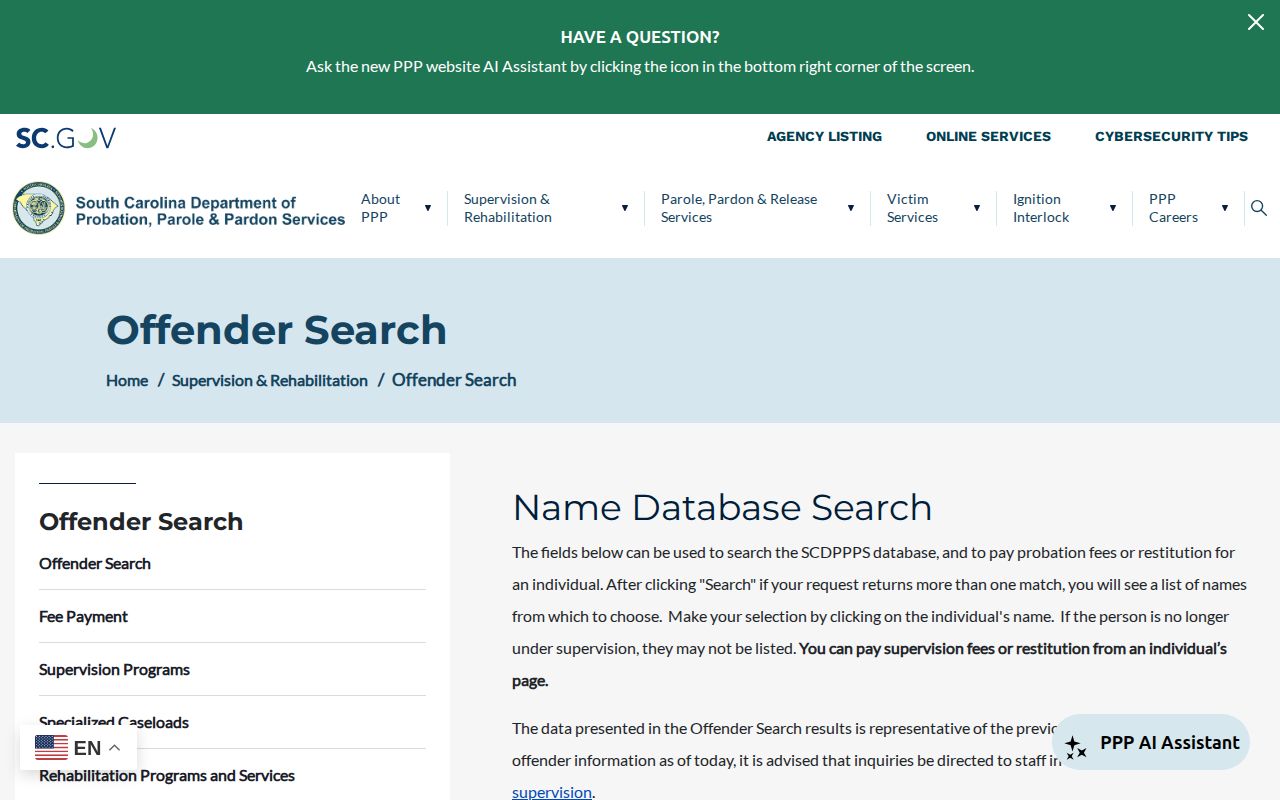
A positive result supports continuing supervision as of that data date, while a negative result does not establish unrestricted release or sentence discharge.
SCDC Release Types and Trends
SCDC reported 5,708 releases from its base population in fiscal year 2025, which ran from July 1, 2024 through June 30, 2025. That total followed 5,186 in fiscal year 2024 and 5,731 in fiscal year 2023. The published research comparison describes a 10.1 percent rebound after a 9.1 percent decrease. These figures count SCDC release events from the base population. They are not a count of all county-jail exits, and they do not mean each person was free of all supervision or other custody.
The fiscal year 2025 mix shows why release is not one legal result. Expiration less permitted credits made up 39.5 percent. Community supervision accounted for 17.9 percent, probation for 17.7 percent, and supervised reentry for 15.2 percent. Together, the supervised categories show many true prison departures that did not equal the end of state authority. Exact categories matter more than a broad statement that someone “got out.”
The SCDC fiscal year 2025 release table supplies the dated statewide count and type breakdown. Use its report year and population definition whenever comparing releases, since a statewide prison total does not measure local jail turnover.
SCDC Release-Day Records
SCDC Policy OP-21.09 gives a detailed release audit. Staff verify the legal authority, date, detainers, disciplinary data, convictions, prior record, registry and DNA screens, and other required entries. A release certificate applies to community supervision, supervised furlough, supervised reentry, parole, and Youthful Offender Act parole to SCDPPPS. The certificate is normally provided at release. A transfer to law enforcement on a detainer changes that handling because the person is moving to another custodian.
The policy also documents an SCDC identification-card release sticker, the return of stored identification, keys, a Social Security card, and personal property. Family may supply release clothes. Otherwise, the institution supplies clothing, and the person does not leave in an SCDC uniform. Staff record a post-release address and telephone number. These are state-prison steps, not rules for every South Carolina county jail.
The official SCDC Victim Services page provides a separate agency channel for state-prison status and release information.
That service route does not replace the released list's actual date and type or the formal victim-registration process handled by the division.
Transportation depends on need and approval. When a bus ticket is required, staff verify the destination. With no reason for another destination, an in-state ticket may route toward the recorded home or family, the county of conviction, or a documented destination allowed by policy. The ticket may stop at the closest bus-route point, leaving onward travel to the person released. No official source reviewed establishes a fixed state-funded gate-money award.
Account policies instead concern the person's own funds. A person scheduled for release may ask for a check from a Cooper Trust Fund balance, usually in advance. A later written and identity-verified request may be mailed, but walk-in check pickup is not available. Work-release balances have separate rules, including mandatory-savings treatment for people released to DPPPS supervision.
The SCDC programs and reentry page describes preparation that begins during confinement.
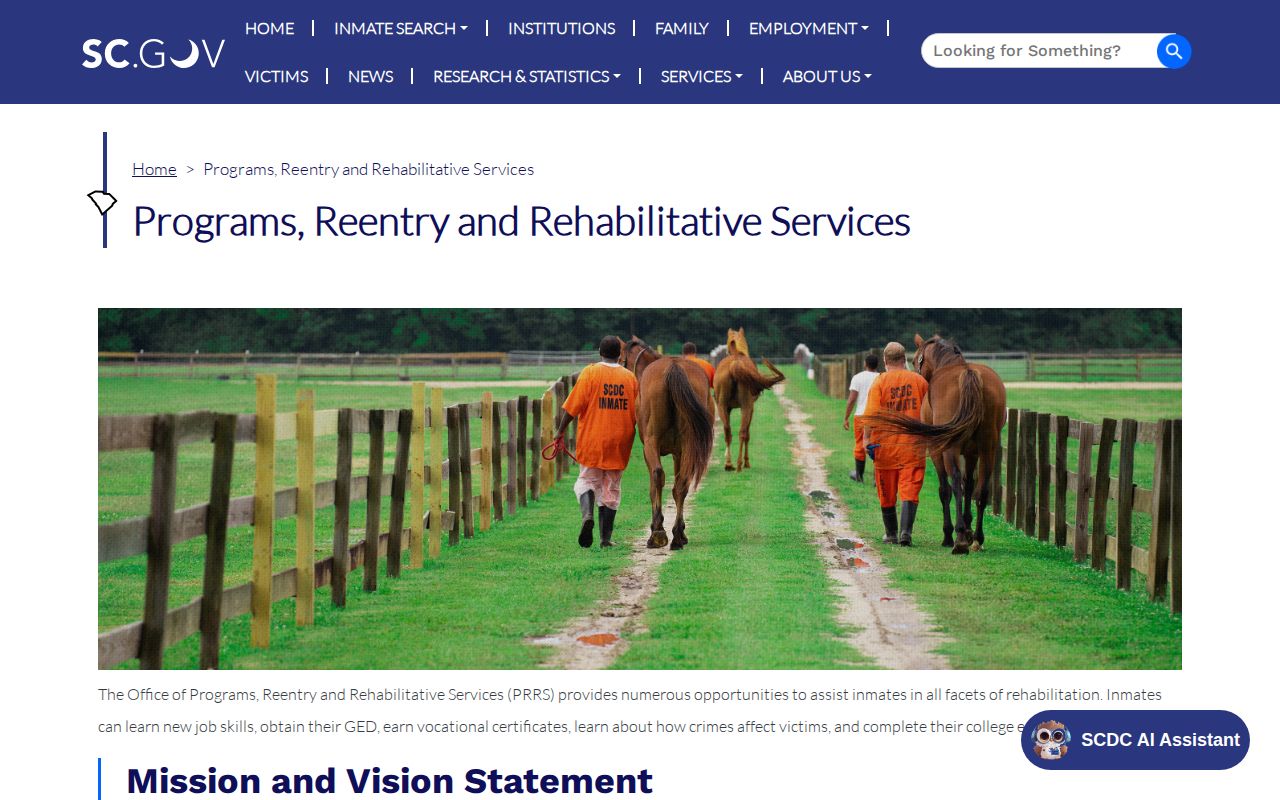
Agency planning can include identity documents and transition preparation, but the release record still controls the date and legal type of exit.
Note: SCDC's documented packet and personal-account process do not support claiming that every released prisoner receives a fixed cash grant.
SCDC and County Releases
The SCDC offender search covers the state-prison layer. A county jail may hold a person before trial, after a local sentence, pending transport, or for another agency. Bond, recognizance, dismissal, time served, or a court order can end the local jail stay. Transfer to SCDC, another county, BOP, ICE, or another authority also ends that roster episode without proving a return to the community. For a local record, start with the custodian and use the statewide County Directory to reach the correct county source.
| Question | SCDC state prison | County detention |
|---|---|---|
| Current custody | SCDC Incarcerated Inmate Search | Local jail or sheriff roster, when published |
| Past exit | SCDC Released Inmate Search or SCDC record | County release record and related court docket |
| Key evidence | Actual Release Date, Release Type, and export fields | Recorded release time, authority, type, and receiving custodian if maintained |
| Transfer risk | Detainer, remand, or another authority may follow | Transfer can be to SCDC, another jail, BOP, ICE, or another custodian |
A federal sentence uses the BOP Inmate Locator, not SCDC. Immigration custody uses the ICE locator for qualifying current or recent custody. A court docket can corroborate bond, disposition, sentence, or an order, but it is not a live custody feed. The operator that held the person owns the most direct exit record.
SCDC Release Records Requests
Try the free released-list search and export first. When online depth is too short, a field is missing, or a formal agency response matters, make a focused written request under the South Carolina Freedom of Information Act. Name the person, give the SCDC or booking number when known, state an approximate admission and release span, and ask for existing records rather than a new analysis. Useful fields include admission and release timestamps, release type and authority, destination or receiving custodian if recorded, sentence and public offense information, and any releasable institutional photograph.
- Describe the existing SCDC record in plain terms and narrow the date range.
- Include the requester's name, address, and phone number as SCDC requires.
- Send the request to the FOIA Coordinator, Office of General Counsel, South Carolina Department of Corrections, P.O. Box 21787, Columbia, SC 29221-1787, or FOIA@doc.sc.gov.
- Ask for segregable public portions when an exemption applies, with protected information redacted.
- Compare the response with the released-list row, court record, and supervision record before drawing a conclusion.
Published SCDC fees reviewed for the research were $0.10 per black-and-white page, $0.25 per color page, and $18.95 per hour for qualified search, retrieval, and redaction. They may change. State law permits actual search, retrieval, and redaction cost at the lowest-paid qualified employee rate, no per-page charge for electronic transmission, and a deposit up to 25 percent.
The usual determination deadline is ten business days, or 20 business days for material more than 24 months old. After approval and any required deposit, production is generally due within 30 calendar days, or 35 for older material, unless the parties agree in writing to more time. Exemptions can protect parts of law-enforcement records, but they do not justify withholding segregable public portions that can be released after redaction.
For search help, SCDC publishes a public inmate-information number at 1-866-727-2846 and Inmate Records at 803-896-8531. Current public-data errors may be sent to Ombudsman@doc.sc.gov. Those contacts serve different tasks, so state whether the issue is a current profile error, an old release, or a formal records request.
Public Record Search
Sponsored Results